
Winter Structure in the Wetland Garden
The Quiet Language Underfoot
Walk into a damp field in early June and you are standing on a set of decisions made by soil, water and people over decades. The plants around your boots are not a random collection; they are a community sorted by conditions. Once you can recognise the main players, the landscape becomes legible. Reading a fen is rather like reading a parish record — inferring what happened from what survived.
The skill is not naming every species. It is noticing which few plants dominate, and asking what those plants tolerate, require and resent.
Sedges: A Diary of the Water Table
Sedges are the best single group for reading wet ground. They are not grasses, though they look it: their stems are usually triangular, and their leaves often have a pleated or keeled look. Different species sort themselves with striking fidelity along gradients of wetness and base-richness.
- Greater tussock-sedge (Carex paniculata) builds those haystack tussocks in fen and alder carr. It tells you of permanently wet, low-oxygen ground, often with some nutrient flushing.
- Bottle sedge (Carex rostrata) points to acid, nutrient-poor fen, often on floating rafts or quaking bog margins.
- Carnation sedge (Carex panicea) prefers neutral to calcareous flushes and damp pasture — a good sign of land that has escaped drainage and heavy fertiliser.
- Common sedge (Carex nigra) is the generalist of seasonally wet, mildly acid ground, often in rush pasture.
Pair the sedges with rushes and the picture sharpens. Soft rush (Juncus effusus) thrives on wet ground that is also disturbed or poached, so an abundance of it often means heavy grazing or failed drainage rather than pristine marsh. Sharp-flowered rush (Juncus acutiflorus) prefers flushed, acidic pasture on seeping slopes, while hard rush (Juncus inflexus) indicates heavy clay that is winter-wet but summer-dry.
Grasses and the Soil Beneath Them
Grasses are equally candid about fertility and disturbance. Purple moor-grass (Molinia caerulea) dominates acidic, peaty ground — wet heath, moorland edge, poor fen — and usually signals burning or light grazing. Tufted hair-grass (Deschampsia cespitosa) forms coarse tussocks on heavy, poorly drained soils, and takes over where land is overgrazed in summer or simply neglected. Crested dog's-tail (Cynosurus cristatus) belongs to well-drained neutral pasture grazed steadily for generations.
Two more are worth learning early. Sweet vernal-grass (Anthoxanthum odoratum) is the sweet-smelling marker of old, unimproved hay meadow; if it is abundant, the field has probably never been reseeded. Yorkshire fog (Holcus lanatus) does the opposite job, flourishing on nutrient-rich, disturbed or improved ground — its abundance warns of enrichment.
Wildflowers and the Hand of Management
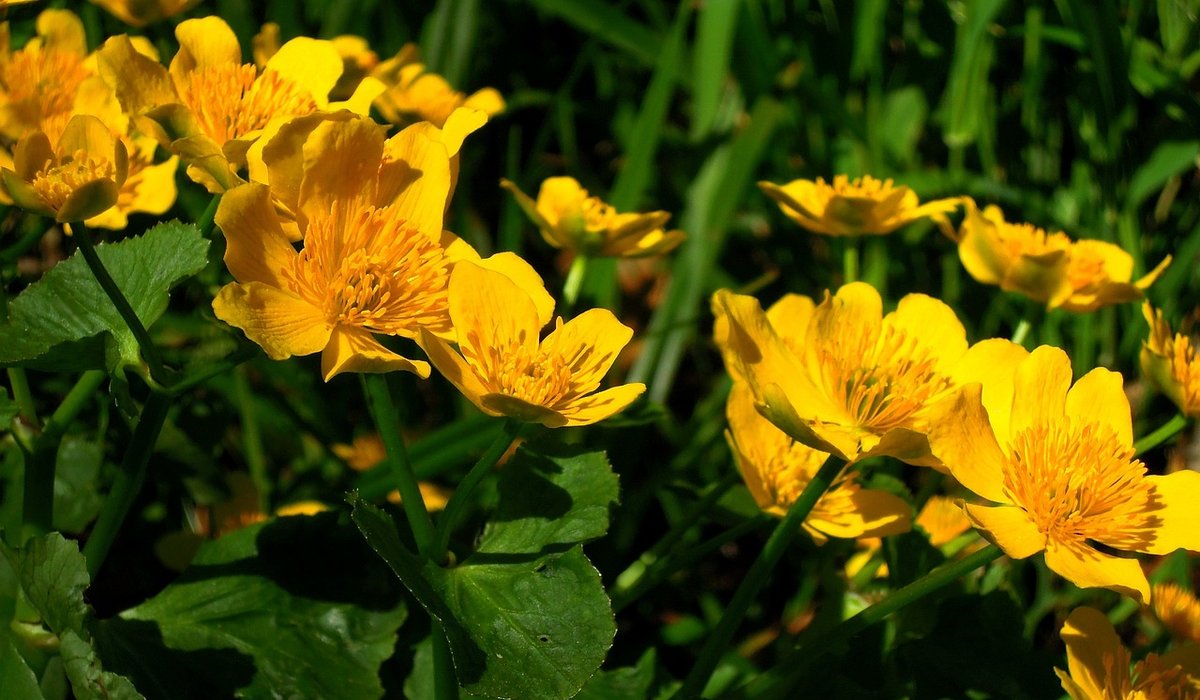
Wildflowers record people as much as soil. A sward with ragged robin, meadowsweet and marsh marigold is usually traditional hay meadow: cut late, after seeds have set, and rarely fertilised. Add devil's-bit scabious, sneezewort and meadow thistle and you have something rarer — unimproved fen meadow managed by light grazing rather than cutting alone.
Wetter, less disturbed ground brings its own cast. Purple loosestrife and bogbean favour base-rich, quietly wet fen. Sphagnum, where it carpets the ground and begins to build peat, tells you the water is acidic, permanently waterlogged and almost free of nutrient input. Absence is evidence too: a sedge that stops at the field boundary, a missing orchid, each gap points to a change in drainage, ploughing or enrichment.
Reading Pattern Rather Than Plant
Single species are useful; their arrangement is better. Look for transitions. Where purple moor-grass gives way to tufted hair-grass at the foot of a slope, you are probably crossing from peat to mineral soil. Where soft rush fringes a stand of greater tussock-sedge, you may be at the edge of deeper water or the line of an old ditch. A mosaic of sedge, rush and wildflower tells you the water table fluctuates rather than sitting at one level, which is often the most botanically rich condition of all.
Boundaries reveal management, too. Straight lines of the same species usually mean mowing, ploughing or drainage. Patchy, species-rich edges, with tussocks and litter left standing, suggest low-density grazing by cattle or ponies, which creates the uneven structure many wetland plants need.
Putting It Together in the Field
You can begin reading a site in five minutes, with no keys and no notebook.
- Stand still and name the three most abundant plants. These set the baseline conditions.
- Note the ground beneath them: bare peat, clay, silt, tussocks, standing water.
- Walk from the wettest spot to the driest and watch which species drop out first. That sequence is your water-table gradient.
- Look at the field next door. If it is greener, simpler and dominated by ryegrass or Yorkshire fog, yours is probably the older and more interesting one.
- Ask what is missing. Absent species often say more about history than present ones.
Read enough wetlands this way and plants stop being a list. They become a record of water, soil, grazing and neglect — a landscape's own account of itself, written in sedge, rush and flower, and legible to anyone willing to stand still and look.
LEAVE A COMMENT